


When considering the beings living on a sphere it is easy for us to differentiate between the sphere and some plane surface: we actually see the sphere being curved. But when it comes to us, and our curved space, we cannot see it since this would entail our standing outside space and looking down on it. Can we then determine whether space is curved by doing measurements inside it?
To see that this can be done let's go back to the beings on the sphere. Suppose they make a triangle by the following procedure: they go form the equator to the north pole along a great circle (or meridian) of the sphere, at the north pole they turn 90o to the right and go down another great circle until they get to the equator, then they make another 90o turn to the right until they get to the starting point (see Fig. 7.18). They find that all three lines make 90o angles with each other, so that the sum of the angles of this triangle is 270o, knowing that angles in all flat triangles always add up to 180o they conclude that the world they live on is not a flat one. Pythagoras' theorem only holds on flat surfaces.
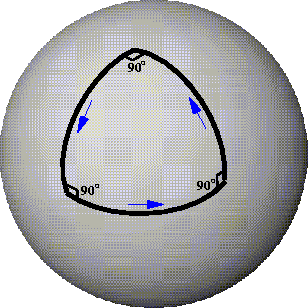
Figure 7.18: A path followed by a determined being living on the surface of a sphere; each turn is at right angles to the previous direction, the sum of the angles in this triangle is then 270oindicating that the surface in which the bug lives is not flat.
We can do the same thing: by measuring very carefully angles and distances we can determine whether a certain region of space is curved or not. In general the curvature is very slight and so the distances we need to cover to observe it are quite impractical (several light years), still there are some special cases where the curvature of space is observed: if space were flat light would travel in straight lines, but we observe that light does no such thing in regions where the gravitational forces are large; I will discuss this further when we get to the tests of the General Theory of Relativity in the following sections.
The curvature of space is real and is generated by the mass of the bodies in it. Correspondingly the curvature of space determines the trajectories of all bodies moving in it. The Einstein equations are the mathematical embodiment of this idea. Their solutions predict, given the initial positions and velocities of all bodies, their future relative positions and velocities. In the limit where the energies are not too large and when the velocities are significantly below c the predictions of Einstein's equations are indistinguishable from those obtained using Newton's theory. At large speeds and/or energies significant deviations occur, and Einstein's theory, not Newton's, describes the observations.
The theory of curvature is a central branch of mathematics (differential geometry) and physics that studies how much a geometric object—whether a line, a 2D surface, or 4D spacetime—deviates from being flat or straight.
Depending on the dimension and context, curvature ranges from simple geometric measurements to complex tensor equations in general relativity.
1. Curvature of a 1D Curve
For a simple curve, curvature ($\kappa$) measures how rapidly the curve changes direction as you move along it.
Straight Line: $\kappa = 0$ (does not bend at all).
Circle of Radius $R$: $\kappa = \frac{1}{R}$.
A smaller circle bends more sharply, giving it a higher curvature; a larger circle approaches a flat line and has a lower curvature.
2. Curvature of 2D Surfaces (Gaussian Curvature)
When moving to surfaces, Carl Friedrich Gauss proved the Theorema Egregium ("Remarkable Theorem"), showing that curvature can be measured purely from inside the surface itself without referencing a higher dimension.
At any point on a surface, there are two perpendicular directions of maximum and minimum bending, called principal curvatures ($\kappa_1$ and $\kappa_2$). Their product is the Gaussian Curvature ($K = \kappa_1 \cdot \kappa_2$):
Surface Type
Gaussian Curvature (K)
Geometric Behavior
Example
Positive
$K > 0$
Bends in the same direction along both axes. Triangles on this surface have angle sums $> 180^\circ$.
Sphere, dome
Zero (Flat)
$K = 0$
At least one direction is straight. Can be flattened without stretching or tearing.
Flat sheet, cylinder, cone
Negative
$K < 0$
Bends upward in one axis and downward in the other. Triangles have angle sums $< 180^\circ$.
Saddle, Pringles chip, hyperboloid
3. Higher Dimensions: Riemannian Geometry
In 1854, Bernhard Riemann extended curvature to spaces of 3, 4, or $n$ dimensions. In multi-dimensional spaces, a single number isn't enough to describe bending; instead, mathematicians use tensor fields:
Riemann Curvature Tensor ($R^\mu_{\nu\alpha\beta}$): Captures all information about how vectors change when moved parallel around a closed loop.
Ricci Tensor ($R_{\mu\nu}$) & Scalar ($R$): Simplified contractions of the Riemann tensor that measure how volume changes compared to flat Euclidean space.
4. Curvature in Physics: Einstein’s General Relativity
In 1915, Albert Einstein applied Riemann's theory of curvature to physics, revolutionizing our understanding of universe. He proposed that gravity is not an invisible pulling force, but rather the curvature of 4D spacetime caused by mass and energy.
In Einstein’s Field Equations, curvature on the left side is directly produced by matter and energy on the right side:
$$G_{\mu\nu} = \frac{8\pi G}{c^4} T_{\mu\nu}$$
$G_{\mu\nu}$ (Einstein Tensor): Describes the curvature of spacetime.
$T_{\mu\nu}$ (Stress-Energy Tensor): Describes the density and flux of energy and momentum.
Objects in free fall (like planets orbiting the Sun or falling apples) simply follow the straightest possible paths (geodesics) through this curved spacetime